On Decoy Books
*
Čiricaitė, E. (2026) 'On Decoy Books: Do Judge the Book by its Cover'. In: Artist's Book Yearbook 2026–2027. Bristol: Impact Press, pp. 22–31.
Decoy artist books are works of art that imitate design conventions of familiar book genres. Drawing on relevance theory, I examine how these books manipulate contextual cues, such as size and paper choices, to create a richer search for meaning — as in Ulises Carrión's Looking for Poetry / Tras la poesía, which mimics a slim poetry volume but offers a conceptual meditation on poetry itself. By appropriating the visual and material codes of other book genres, decoy books create a gap between what the object promises and what it delivers. By asking readers to reconcile that gap, those artist books critique, question, amplify, reimagine, dismantle various kinds of booknesses that books embody, prompting a more nuanced and critically attentive mode of reading.
*
Most books are designed precisely to be judged by their covers. Over centuries, distinct design conventions have developed across genres, with visual and tactile cues shaping readers' expectations of a book's purpose and content, even before it is opened. Decoy artist books exploit this by simulating visual signs of mainstream publishing genres.
The notion of decoy books was born not out of my book-making practice, but from thinking about reading habits: how artist books engage the audience, how the audience reads them. It was born in one conversation at the RADA cafe in Bloomsbury, when I was introducing artist books to a person who was new to the field: a person from outside contemporary art and writing practices; a curious person, yet somebody who is more familiar with fin de siècle music than the Small Publisher's Fair. I was giving an example of Ulises Carrión's Looking for Poetry / Tras la poesía — how successfully it functioned as a book, yet its meaning emerged not from the words flooding the pages, but through the whole space of the book, from the multitude of intangible cues arising from the sequencing of words and design choices. With just two words and eight purple lines per page, the book plays with the reader's ability to connect those words, visualise the concepts, connect the words and the lines, and open themselves to the many possible spaces where poetry can exist. It is a remarkable book. One of my favourite artist books. My companion noted that the book resembled a DIY poetry compilation, or a poet's notebook, typically carried around in a pocket. And indeed, we said, Looking for Poetry / Tras la poesía would not look out of place on my poetry shelf. Carrión believed that the best artist books are accessible artist books, that they look and function like ordinary books, possibly through mimicry of other well-known book genres.1 Looking for Poetry / Tras la poesía is a good example of such thinking. It is a small pocket-sized publication, which fits easily into the hand: the size of a small, intimate poetry volume, like a haiku collection. One could say that Carrión mimicked the size, weight, and physical experience of a poetry collection. One could even say that Looking for Poetry / Tras la poesía is a decoy book created to imitate certain design conventions of an established genre: to seduce through familiarity, only to reimagine the genre through material, textual, or conceptual divergence.
Decoy is not a term that exists in the arts or aesthetics theory. It is a word more frequently used in hunting, military, or cybersecurity literature to denote simulated look-alike objects or systems that divert attention. The idea of the decoy can therefore be entangled with the ideas of the fake and appropriation, and then with the Trojan Horse theory of art, and from here into various political and cultural critical discourses. It is also possible to expand the notion through the lens of semiotic systems, interrogating how decoy functions as a sign, exposing the codes that govern what a book means and what it does. Here, however (as in my other texts), I want to make a few points from a reader-oriented position rooted in relevance theory. It was from a relevance theoretic debate on artist books and genre that the idea of decoy emerged.
To briefly remind, relevance theory is a cognitive pragmatics theory of language interpretation. Developed by Dan Sperber and Deirdre Wilson in the early 1980s, it builds on philosopher Paul Grice's work on communication and meaning. Although arising from the tradition of British analytic philosophy, it utilises knowledge in empirical psychology and linguistics — and cognitive sciences, more broadly — to explain the processes of interpretation. It looks at language in all contexts of its use: real situations of how we communicate in daily life, as well as how we make sense of poetry, literature (and other language arts), how we experience them, how we arrive at meaningful interpretations, and what effect those interpretations have on us. It is not revolutionary to suggest that a linguistics theory might contribute to arts discourse. Consider, for example, Ferdinand de Saussure's theory of language, which became adapted into structuralist thought as a theory of relational signs; it then became part of Jakobson's textual analyses, Lévi-Strauss' myth analyses, and Roland Barthes's image analyses, surviving to this day in the vocabulary of structuralist semiotics. Every time we talk about signs or signifiers we are referring back to the theory that originated in the study of language.
The notion of the decoy book emerged from the intersection of relevance theory and artist books discourse. Like works of literature or works of art, artist books are ostensive acts.2 In the introduction to Reading Beyond the Code: Literature and Relevance Theory (2018) Terence Cave and Deirdre Wilson say that
the production of a work of literature is an ostensive act which raises expectations of relevance,3 whether through its linguistic register or its generic framing: it seeks to convince the reader that something valuable is being expressed, perhaps all the more so because it is free from the criterion of immediate, practical relevance.4
We accept that works of literature carry a special authorial intention, and that this recognised special intention raises our expectations of relevance, making us focus on those works differently than we would on an obituary or a parking penalty letter. Artist books, too, raise expectations of relevance, both through their intentionality and through the contextual framing within the social and cultural parameters they inhabit. In other words, when reading an artist book, we recognise that unusual design choices are not accidental, that they are integral to the meaning of the artist book, and we therefore read the weight and translucency of paper, or ink choices, with a special focus and attention.5
Thus, when at the Small Publishers Fair we encounter books with minimalist covers, no covers, blank covers, oblique titles, absent titles, pages not unfolding, illegible texts, poems spilling across the table, we do not freak out.6 We appreciate that we are holding an artist book, and we read deviations from book design conventions as authorial intention and necessary to the meaning of the book as a whole. In fact, we (or at least some of us, like myself) even expect a degree of deviation from traditional book design, we seek out a play on such practices, because they are consistent with what an artist book is. Artist books pose a capacity to critique, to question, to amplify, to reimagine, to dismantle various kinds of booknesses7 that books embody, through design, not just their content.
Unlike other forms of publishing, artist books do not always have visual markers that distinguish them from other types of books. Most book genres have evolved into certain recognisable design conventions that act as visual and tactile signals, guiding readers' expectations before they even open a book. Popular philosophy may use abstract covers and serif typefaces to imply seriousness and depth of the content; romance novels may feature cursive titles to evoke intimacy; reference books may adopt restrained designs and simple bindings to emphasise authority and utility. These conventions reflect each genre's function, audience, and cultural positioning. They also construct reading expectations, priming us for certain types of content: storytelling, factual instructions, visual narrative, or reflection, for instance. Artist books, by contrast, do not have a "look" that might prime the reader. Artist books range from timid, modest volumes to extravagant sculptural formations. Furthermore, some artist books inhabit forms of design traditionally associated with those of other genres, visually resembling novels, comics, poetry volumes, devotional books. I call these decoy artist books. They seduce the reader with a familiar design and safe, genre-based expectations, only to challenge the reader with unexpected content.
Consider previously mentioned Ulises Carrión's Looking for Poetry / Tras la poesía. It is a small pocket-sized book that fits easily into the hand: the size of an intimate poetry volume. It imitates formal qualities and the physical experience of a poetry collection (or a poet's notebook). The title, too, leads the reader into thinking that the book may contain poetry or contemplations on the nature of poetry. And indeed, the book is a contemplation on what and where poetry might be, albeit a less conventional one. There are no essays or lyric poems inside. Each page has an identical layout, with eight pink-purple straight lines running along the right side of the spread. A ghost image of the lines is visible on the left side, forming a band which weaves through the book without an interruption. Each page has one English word positioned above the same word in Spanish, such as lines, threads, wires, strings, needles, whips, blinds, shelves, edges, levels, degrees, boundaries, latitudes, spaces, metaphors, etc. As the book progresses through its pages, the nouns gradually change from concrete to abstract; they become less tangible, less physically line-like; the contact between the words and the lines loosens. It becomes increasingly effortful for the reader to connect them literally or even metaphorically (think horizons, hypotenuses, rays, distances, relations, symbols, and metaphors as parallel lines). In this widening gap between words and images, the range of possible interpretations expands, as if poetry itself might be hiding in that chasm. By the final pages, the book guides the reader back to the word poetry, leaving one with a renewed sense of its depth and possibilities. (It is indeed a remarkable publication).
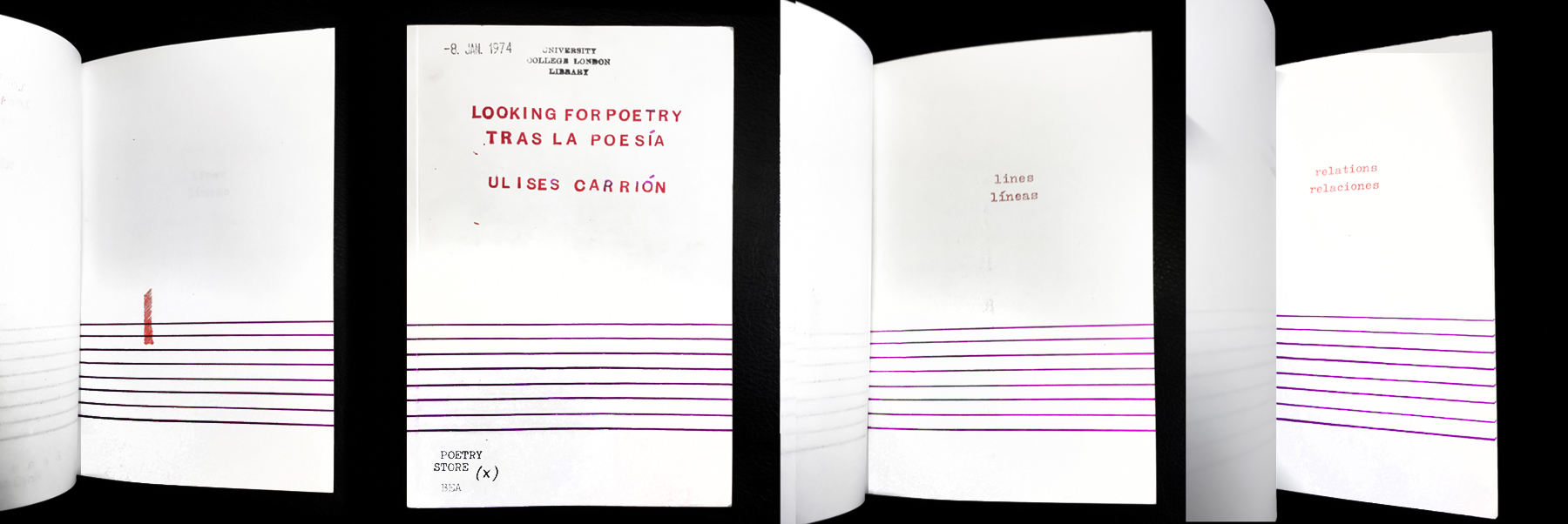
Looking for Poetry / Tras la poesía blends and intertwines the familiar connotations of a poetry book genre with the deeper meanings conveyed within the work itself, thereby suggesting a broader understanding of what poetry is, and what a poetry book is and can be. From a relevance-theoretic perspective, it manipulates contextual assumptions: decoy books present themselves in a familiar guise, prompting readers to engage habitual interpretive patterns — be it a cookery book, a guide book, or a poetry volume — which are then challenged, possibly creating a richer search for relevance as one navigates an array of implicatures whilst reconciling the content and the physical qualities of the book.
Looking for Poetry / Tras la poesía is not unique in the way it simulates the visual signs of a mainstream publishing genre. There is a rich variety of examples, including Secret Recipes for the Modern Wife by Nava Atlas, Touchstone Books, 2009 (mimics the idea of cookery books), Sophie Calle's The Address Book, Siglio Press, 2012 (mimics an address book), Luigi Serafini's Codex Seraphinianus, Rizzoli, 2013 (mimics an encyclopaedic manuscript), Girard-Meunier and Westbom Weflo's Generic Adventures: Insert Title, Charmant & Courtois, 2015 (mimics a retro comic book).8 By mimicking conventional book forms, such books foreground cultural knowledge that allows the reader to quickly infer context. When a book looks like a mass-produced poetry collection, its visual and material cues prime the reader for a particular type of reading experience. When its contents disrupt those expectations, the interference becomes part of the meaning of the book.
Decoy books are not the only "mistaken identity" books. It is worth briefly noting here the fascinating phenomenon of pareidolic artist books. I use pareidolic to refer to unintentional artist books, i.e. the books that we may perceive as artist books and read as such, although they were not intentionally made to be artist books. Pareidolia describes a tendency to perceive likeness (and therefore infer meaning), where there is none, such as seeing a face in an electric socket, Jesus in a piece of toast, or an artist's book in a photographic catalogue of garden sculpture.9
Decoy books are a compelling category within the field of artist books. They thrive on mistaken identity. By functioning as a deliberate "false lead", they expose the assumptions that we, as readers, bring to books. By disturbing the relationship between a book's exterior and its content, those works encourage readers (and artists!) to reflect more deeply on the material, cultural, conceptual dimensions of the book. By asking readers to reconcile the gap between what the object promises and what it delivers, they foreground the significance of formal cues alongside linguistic and visual content, prompting a more nuanced and critically attentive mode of reading.
Artist books often reconfigure formal conventions of the book and reframe its cultural associations — and decoy books are particularly successful at that. By appropriating and manipulating the visual and material codes of other book genres, those artist books critique, question, amplify, reimagine, dismantle various kinds of booknesses that books embody. One may argue that most artist books are decoys to some degree — and they would not be wrong.
Therefore, please, do judge the book by its cover.
*
Notes
1. See his brilliant 1987 lecture Bookworks Revisited for The Evergreen
State College printmaking students in Olympia, Washington State. It is now available as a
video essay online, recorded by B. Ritchie.
←
2. Ostensive acts are intentional acts which signal a person's
intention to communicate. We recognise ostensive acts as a deliberate act of human
agency. Examples of ostensive acts may be — making eye contact before
speaking; tapping a microphone to draw attention to the start of a conference
presentation; publishing an article in the newspaper or putting a painting into a
gallery. ←
3. A work of art or literature raising expectations of
relevance, means it is raising an assumption that the work will provide
information, experience or insights significant enough to justify the effort of
interpreting it. ←
4. Cave, Terence, and Deirdre Wilson, 'Introduction', in
Reading Beyond the Code: Literature and Relevance Theory, ed. by Terence
Cave and Deirdre Wilson (Oxford: Oxford University Press, 2018), pp. 1–14.
←
5. Generally, we do not contemplate paper choice of a council
housing booklet with the same kind of focus. ←
6. By we, I largely mean the kind of audience who
reads ABYB or is otherwise familiar with artist books. However, it is important to
mention that artist books can baffle and bemuse some people, in the same way that
the lack of familiarity with contemporary experimental music may baffle and bemuse
others. ←
7. By "booknesses" here I mean the qualities and
characteristics that make something recognised as a book: such as their physical
form, design conventions, reading habits and traditions, cultural, historical,
philosophical or intellectual contexts. ←
8. Further examples include Legendary, Lexical, Loquacious
Love by Karen Reimer, Sara Ranchouse Publishing, 1996; Unforeseen
Alliances by Anita M-28 (Sally Alatalo), A Sara Ranchouse Romance, 2001;
Silvio Lorusso and Sebastian Schmieg's Networked Optimisation: The Seven
Habits of Highly Effective People, The 5 Love Languages of Love, and How to Win
Friends & Influence People, 2013; Christopher Robinson's books Sunlight
on Cold Water, 2010, Wonderful Clouds, 2010, La Chamade,
2009. ←
9. An essay on pareidolic artist books is forthcoming.
←
*
Bibliography
Bodman, S.L. and Sowden, T. (2010) A Manifesto for the Book. Bristol: Impact Press.
Carrión, U. (1973) Looking for Poetry / Tras la poesía. Cullompton: Beau Geste
Press.
Carrión, U. (1974) The New Art of Making Books. Available at:
reflexionesmarginales.com
Carrión, U. (1980) Second Thoughts. Amsterdam: VOID Distributors.
Carrión, U. (1997) Quant aux livres: On Books. Geneva: Héros-Limite.
Carston, R. and Wilson, D. (2019) 'Pragmatics and the challenge of non-propositional effects',
Journal of Pragmatics, 145, pp. 31–38.
Cave, T. and Wilson, D. (eds.) (2018) Reading Beyond the Code: Literature and Relevance
Theory. Oxford: Oxford University Press.
Chappell, D. (2003) 'Typologising the artist's book', Art Libraries Journal, 28(4), pp.
12–20.
Drucker, J. (2004) The Century of Artists' Books. New York: Granary Books.
Forceville, C. (2020) Visual and Multimodal Communication: Applying the Relevance
Principle. Oxford: Oxford University Press.
Forceville, C. (2025) 'Relevance theory as the foundation for an inclusive theory of communication',
Multimodal Communication, 14(1).
Levinson, J. (1992) 'Intention and interpretation: a last look', In: Iseminger, G. (ed.)
Intention and Interpretation. Philadelphia, PA: Temple University Press, pp.
221–256.
Phillpot, C. (2013) Booktrek: Selected Essays on Artists' Books (1972–2010). Zurich
and Dijon: JRP|Ringier and Les Presses du Réel.
Ritchie, B. (2020) Ulises Carrión Bookworks Revisited [video]. Available at:
youtu.be/_hPeob9gS1E
Silveira, P. (2020) 'A conceptual definition of the artist's book and a new look at Ulises
Carrión's thinking', Artelogie, 15. Available at:
journals.openedition.org/artelogie/4411
Sperber, D. and Wilson, D. (1995) Relevance: Communication and Cognition. 2nd edn. Oxford:
Blackwell.
Wilson, D. and Sperber, D. (2012) Meaning and Relevance. Cambridge: Cambridge University
Press.